Simeis 57 - The Propeller Nebula
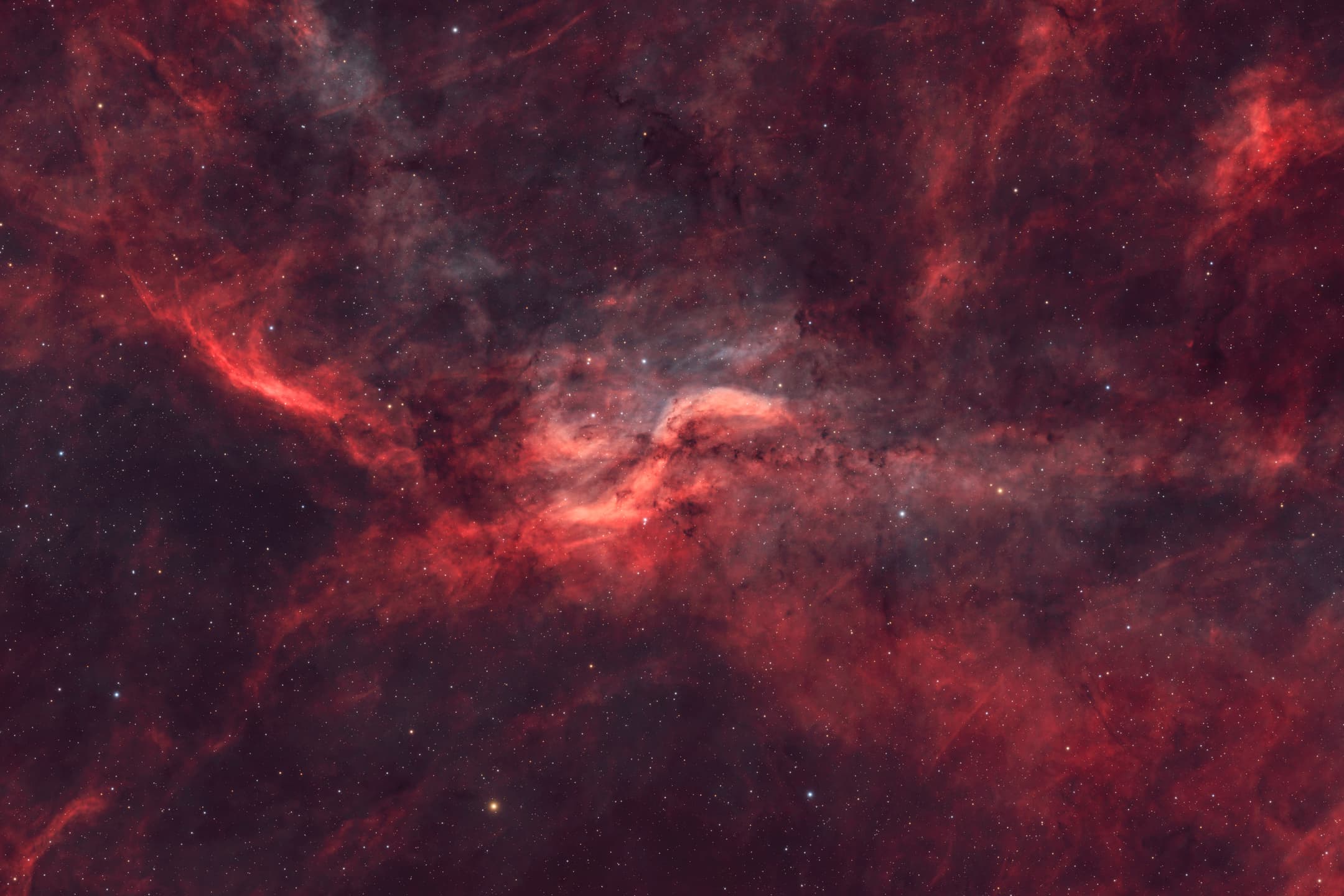
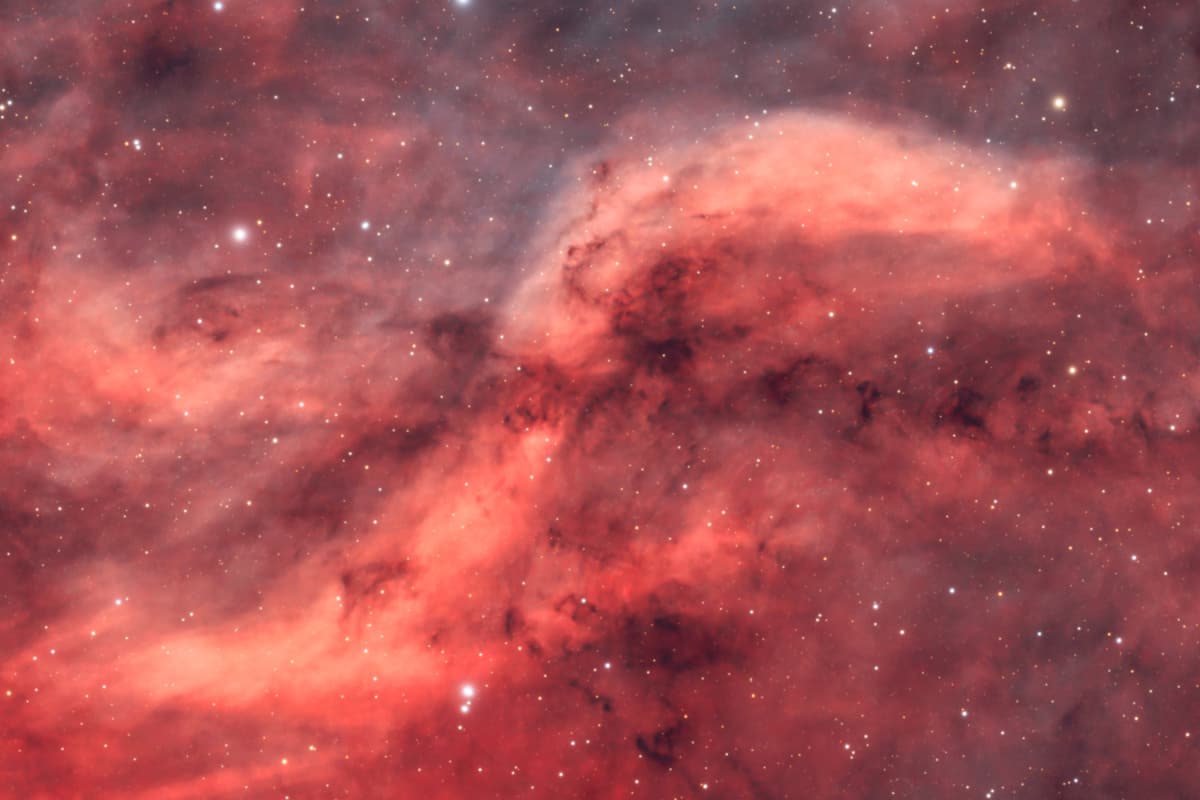
A narrowband SHO view of Simeis 57 in Cygnus, with RGB stars. The Propeller takes the centre and not much more, and the rest of the frame is left to the nebulosity around it.


The object
Simeis 57 is an emission nebula in Cygnus, a few degrees north of Sadr, in the crowded hydrogen of the Cygnus X region. It was found in the early 1950s at the Simeiz Observatory in Crimea, and it's named for its shape: two curved blades of gas twisting around a darker centre. The Dickel, Wendker and Bieritz catalogue lists the blades separately, as DWB 111 and DWB 119, so it often goes by DWB 111, which is only half a propeller.
For decades nobody could say what lights it. There's no bright star inside it, and none obviously close by. A 2021 study points to WR 140, a Wolf-Rayet binary nearly a degree away, which would put the nebula at about 5,500 light-years.
It's small, and here it takes up little of the frame. Most of the image is the neighbourhood, and in Cygnus that's never a bad trade. W63, the Cygnus Shell, is just to the north, outside the frame.
Capture notes
Twelve hours each in Hα, SII and OIII, plus an hour per RGB channel for the stars.
Hα does most of the work. The OIII is faint and patchy, and mostly shows up as the grey-blue haze above the propeller.
Processing
It's mapped SHO, but it doesn't look it. The usual gold and teal would have turned a mostly hydrogen field into a colour scheme, so the palette is pulled back towards red. The OIII is left as a cool haze rather than pushed into a second colour.
The propeller is the brightest thing in the frame by some distance. The hard part was keeping its core from burning out while the dust lanes around it stayed dark enough to read. Stars are RGB, swapped in rather than stretched out of the narrowband.