M33 - Jewels in Triangulum
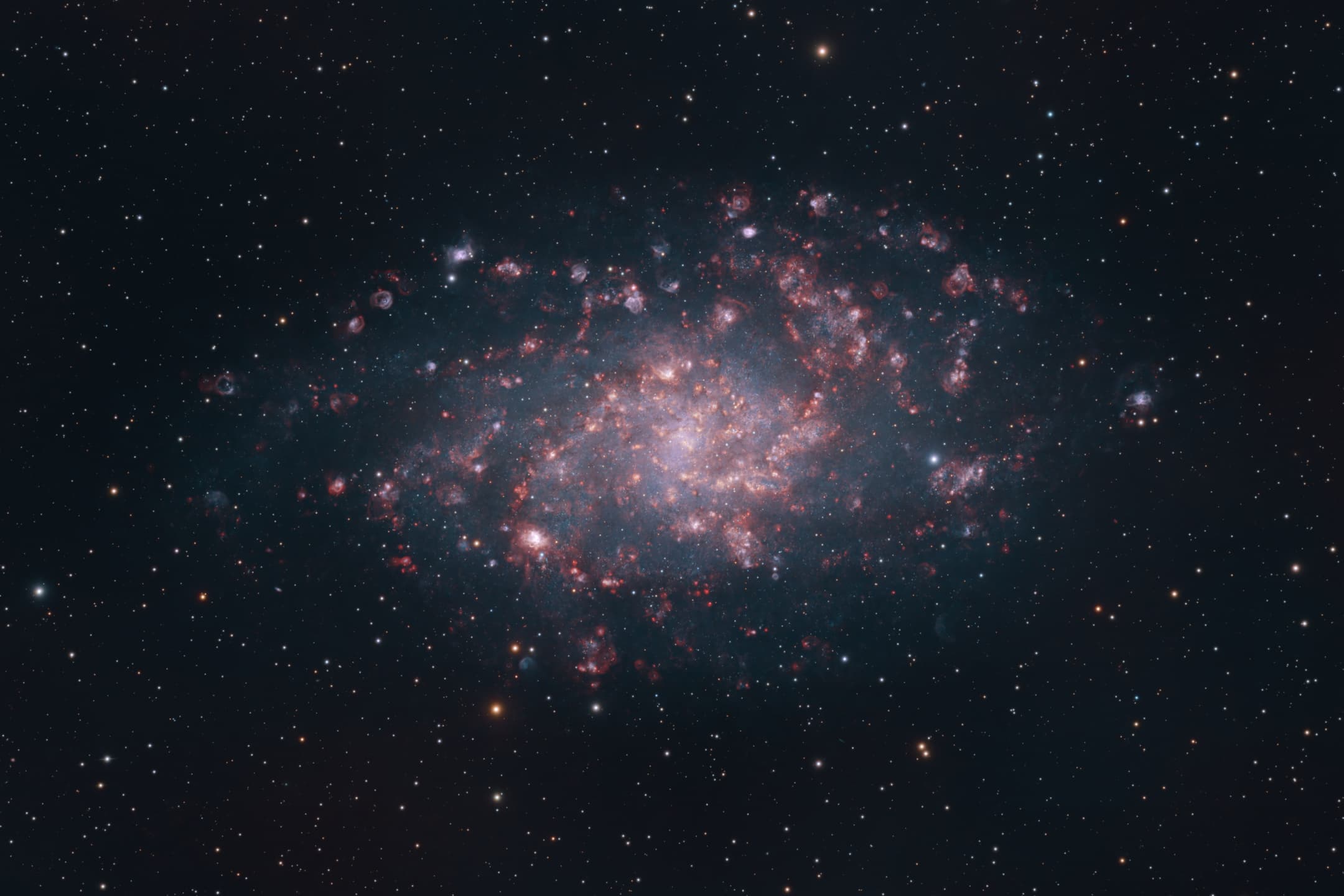
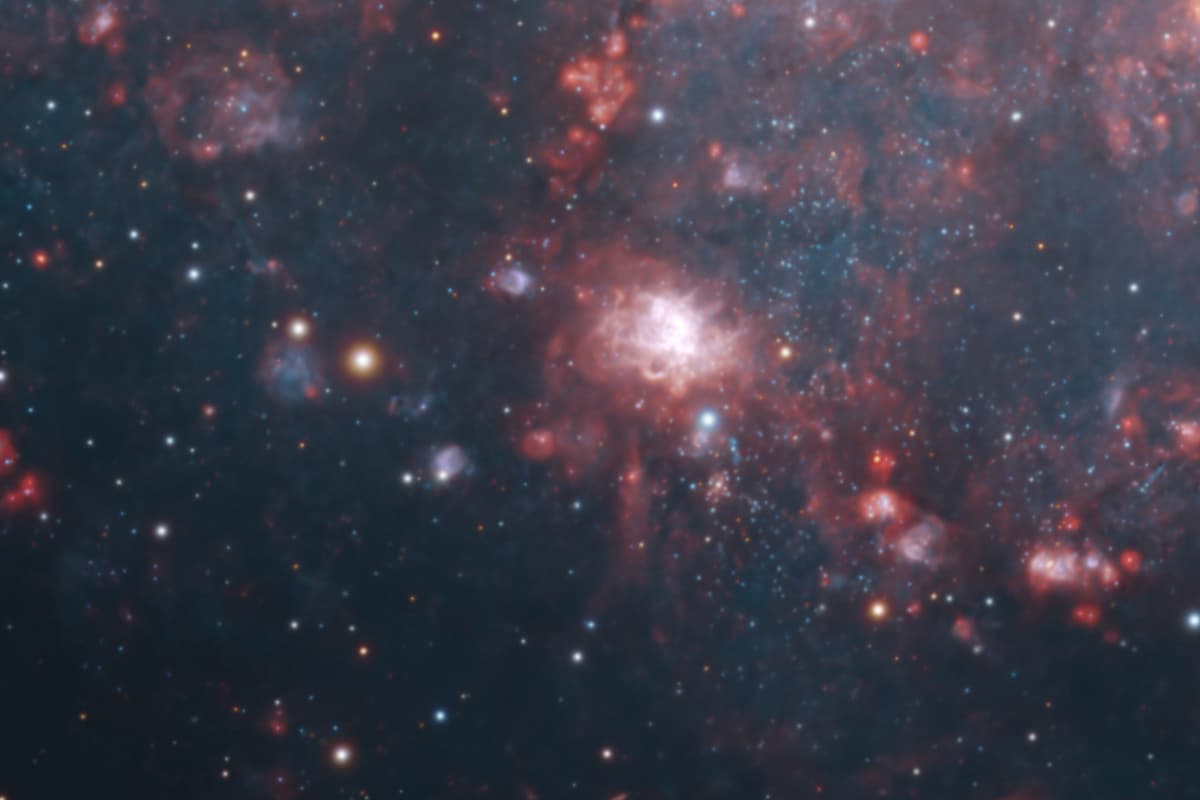
The Triangulum Galaxy in HOO with RGB stars, where the hundreds of HII regions scattered along its arms take over from the spiral itself.


The object
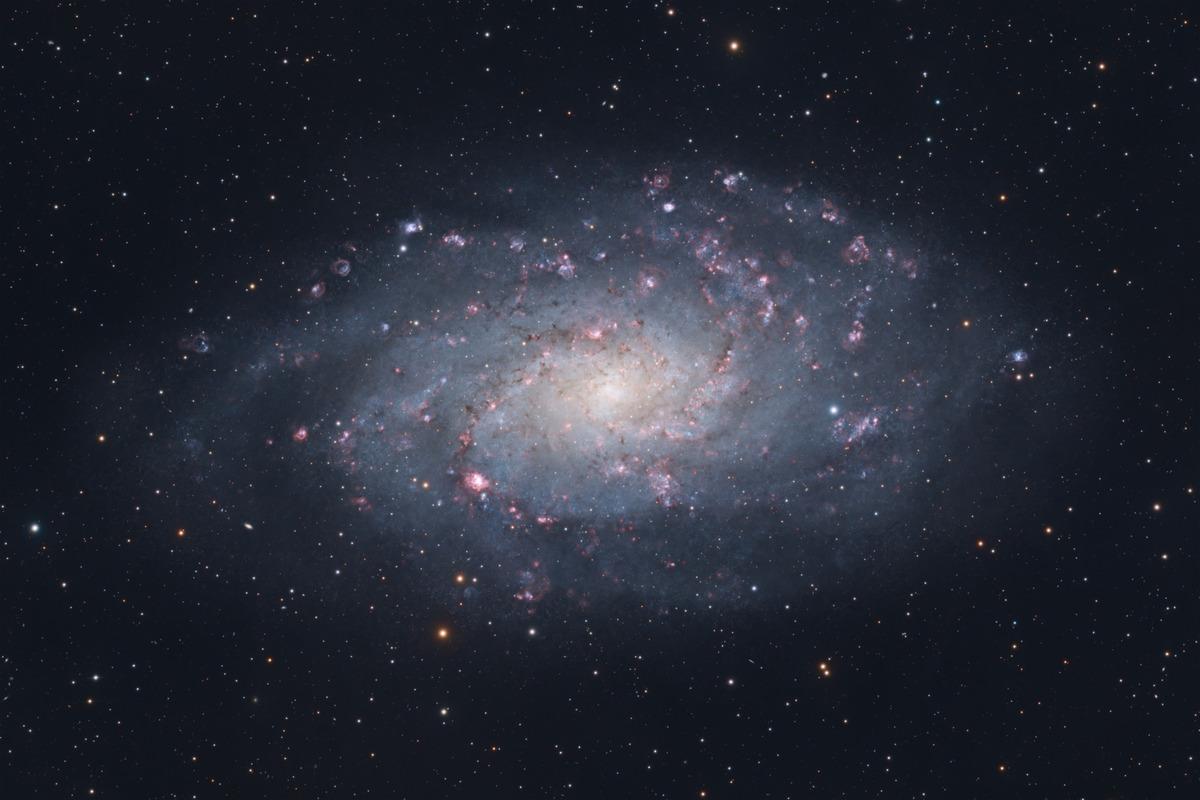
From a distance M33 looks fairly calm. It's the third-largest galaxy in the Local Group, behind Andromeda and the Milky Way, about half the Milky Way's size and roughly 3 million light-years away. In broadband it reads as a soft, loose spiral.
Narrowband changes that. Hα and OIII skip most of the starlight and go straight for the ionised gas, and M33 turns out to be busy almost everywhere: hundreds of HII regions, pockets of gas lit by young, massive stars, strung along the arms and scattered well beyond them. Some are compact knots, others are rings, shells blown open by the stars inside them. Hubble measured its star formation rate at around ten times Andromeda's average.
The brightest is NGC 604, which William Herschel picked out in 1784, twenty years after Messier logged the galaxy itself. It's around 1,500 light-years across, over 40 times the visible extent of the Orion Nebula, and lit by roughly 200 O-type and Wolf-Rayet stars. Within the Local Group, only the Tarantula Nebula in the Large Magellanic Cloud holds more young stars.
Capture notes
This is the same data as the M33 page, without the luminance: 16h 40m each in Hα and OIII, plus four hours per RGB channel for the stars, 45h 20m in total. The RGB was shot for the broadband version, so the stars here have more data behind them than usual.
Processing
HOO: Hα goes to red, OIII to green and blue. The stars are RGB, swapped in rather than stretched out of the narrowband.
The disk still comes through as a pale blue haze, which keeps the galaxy recognisable as a spiral rather than a field of red dots. Most of the work went into lifting the HII regions off that haze. The brightest ones go white where both channels are strong, and the fainter shells and filaments stay red.