WR 134 region
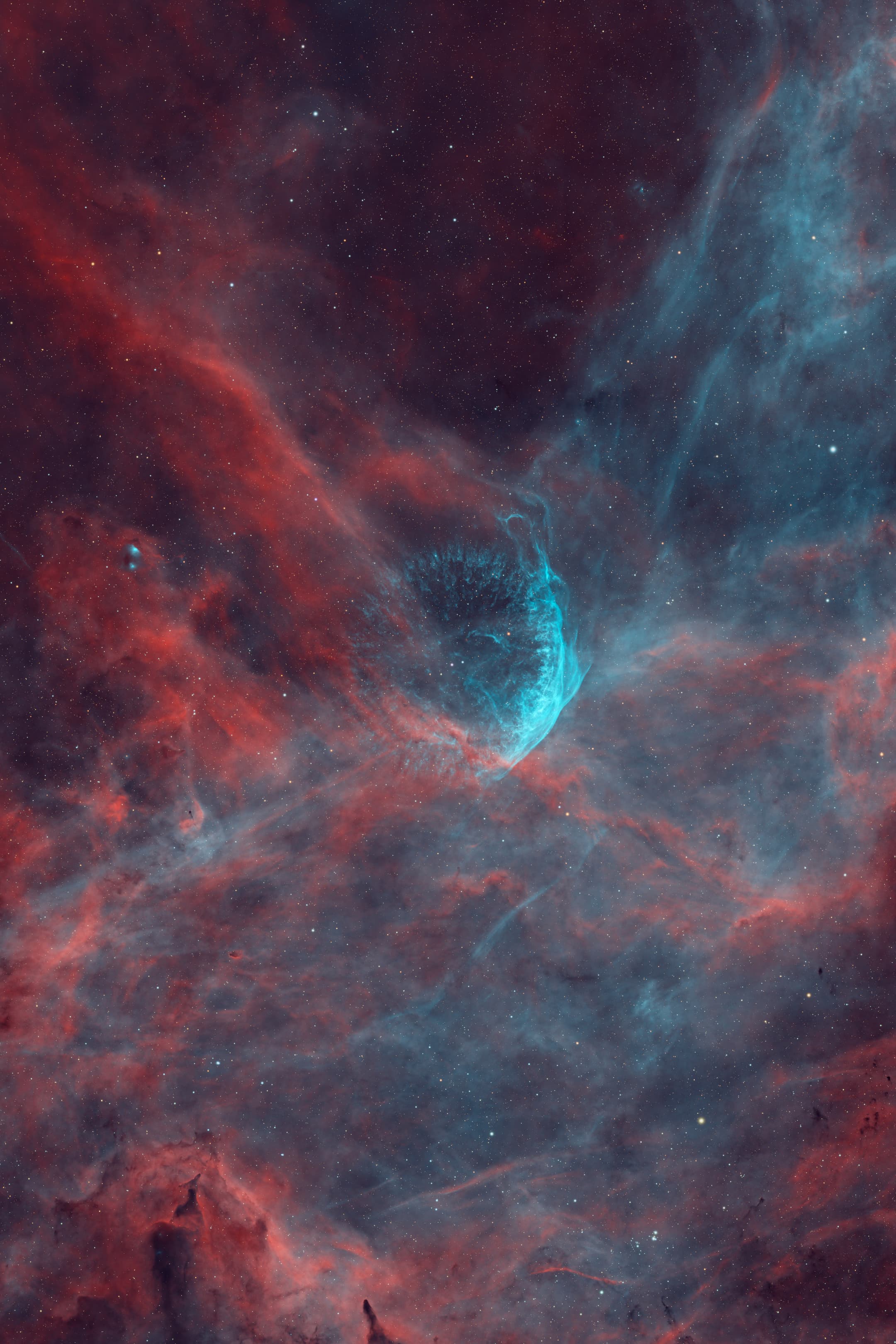
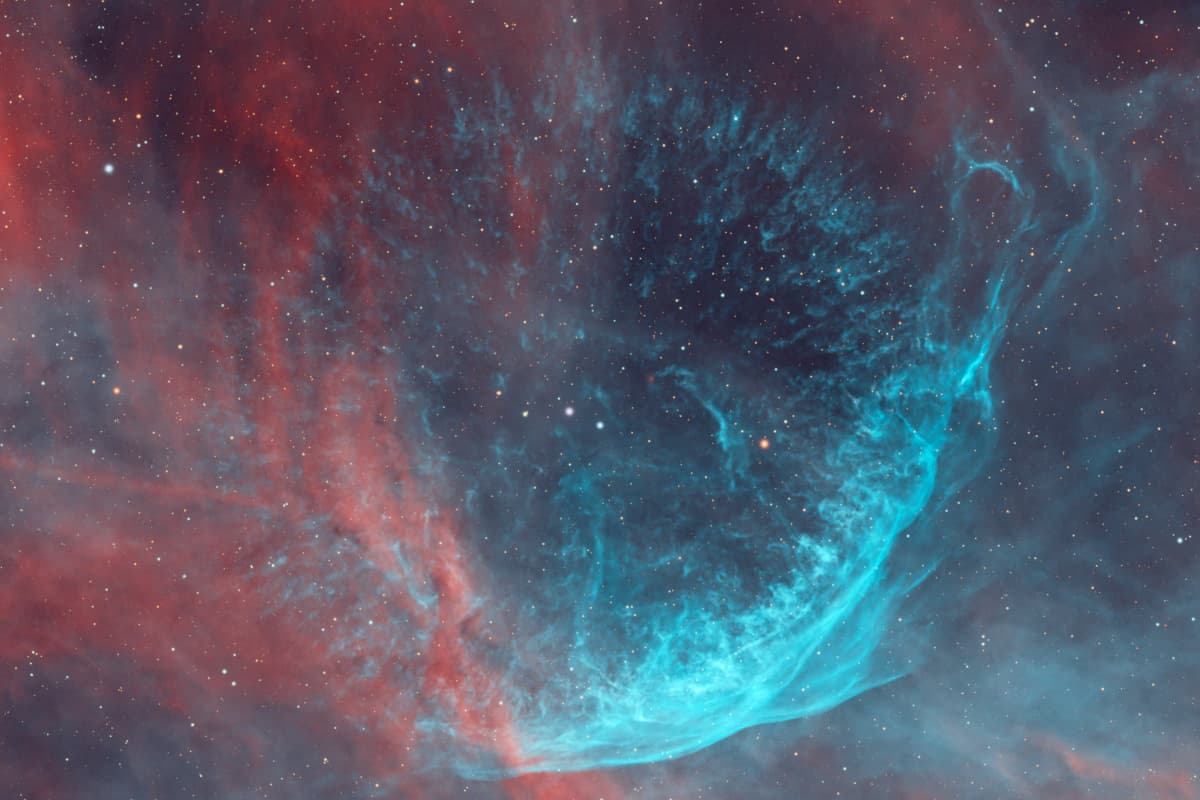
An Hα and OIII view of the field around WR 134 in Cygnus, with RGB stars. The star's wind has blown a shell into the gas around it, and the shell shows up almost only in oxygen.


The object
WR 134 is a Wolf-Rayet star in Cygnus, about 6,000 light-years away. In 1867 Charles Wolf and Georges Rayet, working at the Paris Observatory, picked it out as one of three stars in Cygnus with strangely broad, bright emission lines. The whole class of stars is named after them.
Wolf-Rayet stars are massive stars close to the end, stripped of their outer hydrogen by their own wind. WR 134's wind has blown a shell out of the gas around it, and that's the curved blue edge at the centre of the frame. It's only really bright along one side, and the inside has a fine, combed texture.
WR 135, another of Wolf and Rayet's original three, is in the same frame, about a third of a degree to the east. The two are thought to be at roughly the same distance. Both sit inside a far larger shell of hydrogen, swept up long before either became a Wolf-Rayet.
Capture notes
Forty-eight hours of OIII and twenty-four of Hα, plus four hours of RGB for the stars.
Twice as long in OIII as in Hα, because the shell barely registers in hydrogen. Outside the shell, the same OIII picks up the blue veils drifting across the upper right.
Processing
Hα is red and OIII is blue, and the shell is the only place the oxygen is allowed to get bright. The OIII elsewhere in the frame is real but faint. Stretching it to match would have laid a grey-blue haze over the whole field.
The hard part was the inside of the shell. The combed texture sits only just above the background, and it disappears as soon as the noise reduction gets heavy. Stars are RGB, swapped in rather than stretched out of the narrowband.