NGC 7789 - Caroline's Rose
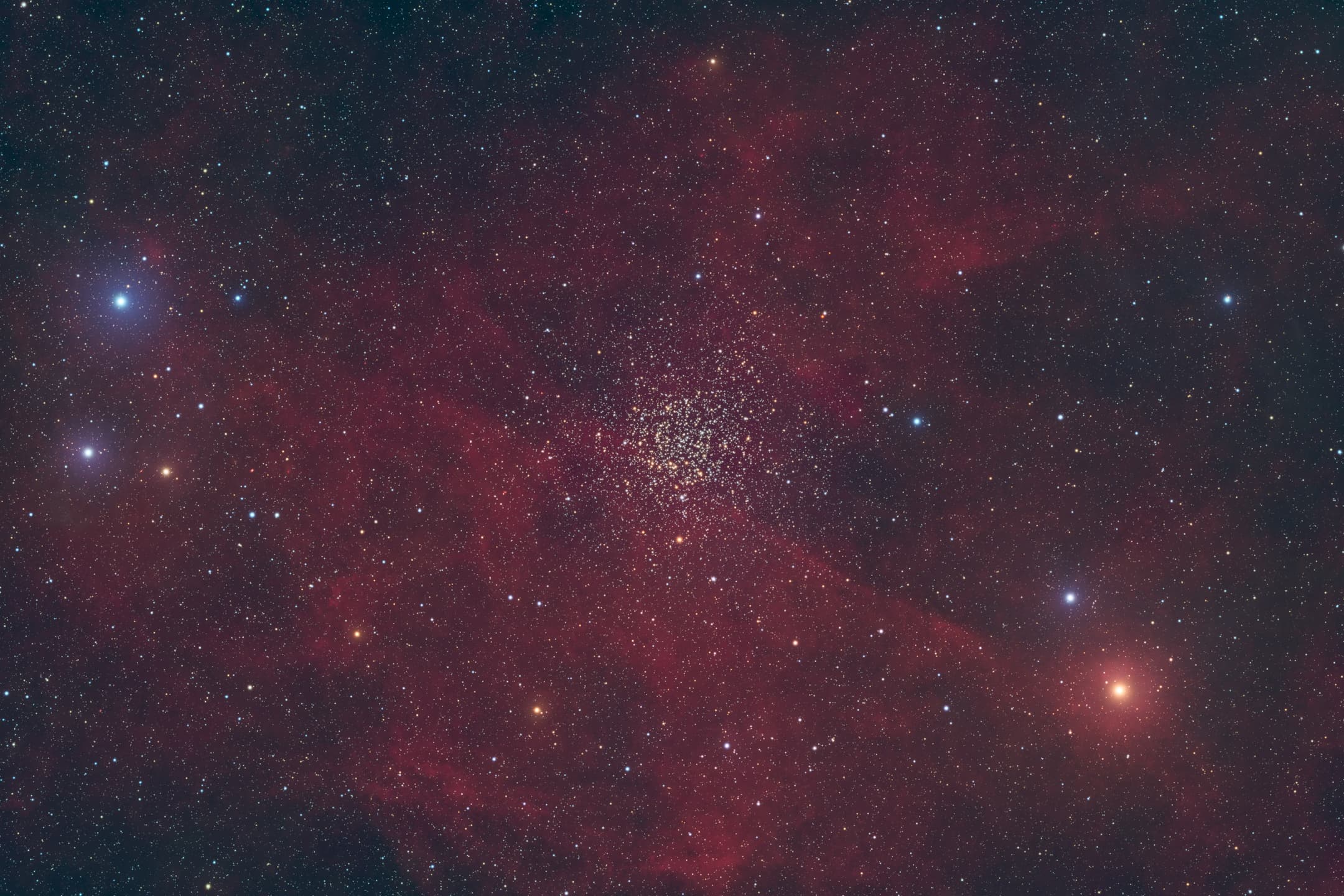
An LRGB and Hα view of NGC 7789 in Cassiopeia, shot under a bright Moon. The hydrogen fills in the field behind the cluster, with the yellow hypergiant ρ Cassiopeiae at its edge.


The object
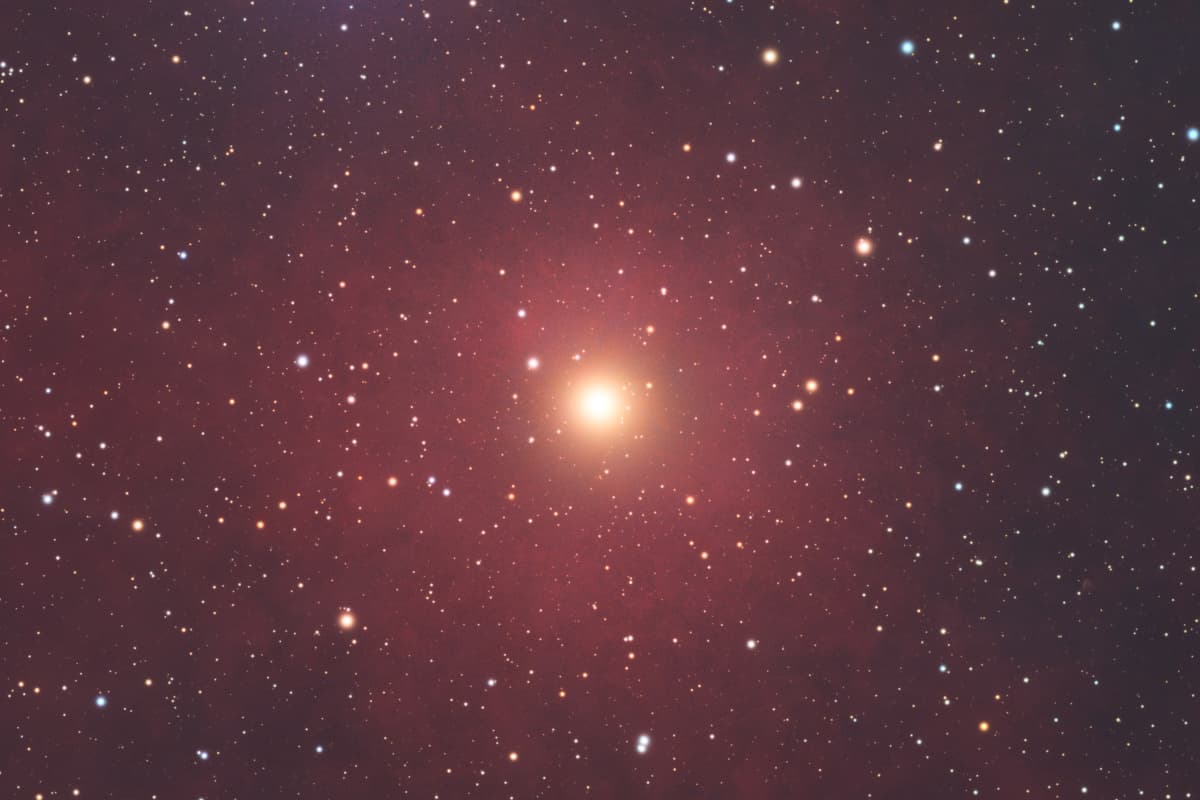
NGC 7789 is a rich open cluster in Cassiopeia, about 7,600 light-years away. Caroline Herschel found it in 1783, and her brother William added it to his catalogue three years later. The name comes from how it looks at the eyepiece: loops of stars with darker gaps between them, like rose petals seen from above.
It holds several hundred stars that formed together and have been drifting through the Milky Way for somewhere between 1.4 and 1.7 billion years. That's old for an open cluster, and it shows in the colours. Look closely and the cluster is peppered with orange giants, stars that have already burned through their youth while their siblings carry on.
The bright orange star at lower right is ρ Cassiopeiae, a yellow hypergiant and one of the rarest kinds of star in the Milky Way. Only a handful are known. It's roughly 10,000 light-years away, though that figure is uncertain, and over half a million times as luminous as the Sun, which is why it's still visible to the naked eye. Every few decades it throws off part of its own atmosphere: in 1893, around 1945, and again in 2000, when it dimmed by a full magnitude for most of a year. It has nothing to do with the cluster; it just shares the view. σ Cas shines blue-white at the top left, on the opposite side of the frame.
Capture notes
Shot between September and October, with every frame taken with the Moon above 80% illumination, the same rule as M13 and M39. Nebulae and galaxies don't stand much of a chance against that much moonlight, but a tight knot of stars holds up surprisingly well.
Would a moonless night have made processing a lot easier? Absolutely. But it beats leaving the telescope parked for a week every month. Most of the time went to Hα, almost seventeen hours of it, because a 6nm filter shrugs off the Moon far better than the broadband ones.
Processing
The Hα brings out the faint hydrogen running through this stretch of Cassiopeia, which gives a "simple" cluster shot a bit more depth behind it. The job was letting it fill the field without tinting the cluster, so the white and orange stars still read as themselves.
ρ Cas was the other problem. A star that bright spreads a wide glow over everything around it, and it's held back just enough to keep its colour without swallowing the stars beside it.
I've grown quite fond of star clusters. Nothing explodes, nothing gets swallowed, there's no cosmic drama at all. Just a family of suns travelling together, quietly, for longer than we can really picture.